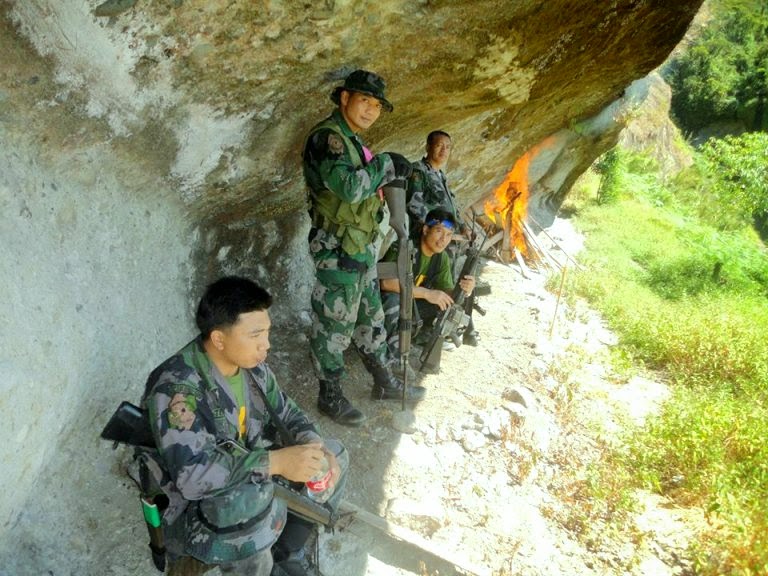
There’s Mt. Ulap, Mt. Pigingan, and Mt. Ugo in Itogon. There’s Mt. Tenglawan, Mt. Lubo, Mt. Kabunian, and Mt. Gedgedayan in Bakun. There’s Mt. Timbak and Mt. Tabayoc in Kabayan. Let’s not forget lesser known mountains that are just starting to pique the interest of climbers. These new trekking destinations include Mt. Marikit in Itogon, Mt. Pukgong in Tublay, and Mt. Dakiwagan in Kapangan.
And then there are the utterly beautiful mountains of Kibungan. The mountain peaks in this far-flung province of Benguet are so numerous that climbing parties usually just use the general terms “Kibungan Circuit”, “Kibungan Traverse,” or “Kibungan Cross-Country” when describing their treks there. Naming every peak you’ve passed during a “circuit” or a “traverse” would eat away at your valuable time. You will need to create a list so as to make sure that you mention every single one of the peaks.
Kibungan is a hiker’s paradise in every sense of the word. Of course, this is subjective and you might think otherwise. I’ve been hiking for years and I’ve come to the point where walking through the trails is more enjoyable than reaching the summit. Even more enjoyable than being rewarded with magnificent vistas at the top. For most people, the apex of their experience during a hike is when they finally set foot on the summit. This is not the case at all with me. I think of “summiting” as just the icing on the cake. It’s nice but it’s not comparable to the experience of hauling yourself up through the trails for hours at a time.
Moving my feet over the trails is a form of meditation, at least for me. I find it very calming. The sounds that my shoes make as they crush dry pine needles or as they disturb puddles on the road are music to my ears. The monotony can go on for hours but I don’t mind it one bit. I’m most comfortable with myself and my being if I’m out there trudging through trails. Nature does something very positive to your well-being which is quite ironic because nature is the most insensitive and inconsiderate entity out there.
Planning and Organizing the Climb
You may not believe it when I say that I was supposed to climb the mountains of Kibungan seven times in the past. Since 2016, I’ve signed up with seven climbing events in Kibungan. However, every single one of these events got cancelled and never pushed through. The seventh cancelled event which was last year was especially memorable because our group of around 14 hikers actually made it all the way to Poblacion in Kibungan. But the tourism office there did not allow us to push through with the hike because of the rainy weather. Yup, we travelled for five hours all the way to Kibungan only to be turned down at the registration area.
But we understood the decision of the LGU there. It’s been raining for several days straight and it can be dangerous at the trails. In fact, on our way to Kibungan, we encountered a landslide near the Kapangan border. We got stuck at the road for an hour or so as we waited for the backhoe and bulldozer that would eventually clear the road for motorists.
Suffice it to say that Kibungan has been very elusive for the past couple of years. Every event there that I signed up with either got cancelled or the organizer simply disappeared without a trace. So throwing caution to the wind, I decided to organize a climb there myself. It has always been my personal policy NOT to organize an event to a place that I’ve never been to myself. I only organize hiking activities in mountains that I’ve climbed already. I broke this policy of mine when I decided to organize a Kibungan Circuit trek. That’s desperation, I have to admit.
What’s funny is that this event I organized nearly got cancelled. Just two weeks before the climb, people who signified their interest in joining the trek started backing out. A group of seven people who were supposed to come from Manila backed out, their reason being it’s been raining and that they are afraid of landslides along the trails. Fortunately, new people signed up for the trek and we were able to reach a comfortable number of hikers: 14. It was on. We were ready to roll.
The Climb
On a cold Saturday morning, the jeep we hired inched its way to Kibungan. I knew most of the people in the group. I’ve known them in treks and trail runs in the past. I was in good company. We reached the registration area in Kibungan earlier than expected so we decided to eat a quick breakfast before heading out. We then registered, paid the necessary fees, signed waivers, then headed to the jump-off point.
I learned that there are two routes on how you can finish the Kibungan Circuit. There’s the regular route and there’s the reverse route. We chose the reverse route. In hindsight, I’m happy that we chose the reverse route because it’s the easier route. That is in consideration of the fact that most of us were first-timers in Kibungan. In mountaineering, this is generally the most common approach when it comes to mountains with multiple routes to the summit. You take the easier routes before graduating to the more difficult ones.
The first section of the trail is a non-stop assault through fields, dirt roads, and community villages. It was hard but fun. The unflinching sun made the climb even harder. The trail featured quite a good number of forks and diversions so it wasn’t a surprise that some of us got lost once or twice on the first day alone. For group climbs consisting of more than ten hikers, it’s always the case that the group gets broken down into smaller sub-groups depending on individual pace. The faster hikers congregate at the head of the trail. Slower hikers congregate down the line. With just two guides, one at the front and one at the tail of the party, hikers caught in between can sometimes head the wrong way. This happened early on in our trek in Kibungan.
Getting lost aside, we all finally made it to a community church upon whose premises we ate our much-deserved lunch. Rested and energized, we pushed forward. After trekking through dirt roads lined on either side with vegetable gardens, we finally reached the trails that cut through Kibungan’s famed mountains. By this time, it was already afternoon. So it was no surprise that we got caught in a heavy rainfall. For several hours, we hiked under the persistent rain. It was a bit disappointing because you can’t enjoy the trails and views as much with the rain all around. We didn’t even stop at Mt. Tagpew’s summit because we’re all just thinking of reaching the camp site as soon as possible. We were denied of fantastic views courtesy of the low-lying and constantly moving clouds and mist.
Due to the rains, we had to change our itinerary. We have to camp at another place. Fortunately, one of our guides know a place deep in the mountains where a man lives. The man has a small house and a hut. Our guide suggested that we can set up tents and camp at his backyard. The Good Samaritan that he is, Manong Rogelio welcomed us with open arms and even helped us set up camp in his yard. He’s an interesting character. He lives alone in this place with his chickens. He also maintains several gardens and farms nearby. Bless his good and accommodating heart.
Pork Sinigang for Dinner
With just an hour of daylight left, we started pitching tents and preparing for dinner. Prior to the climb, we’ve grouped ourselves into meal duties. One team would take care of dinner, another for breakfast the next day, and yet another for lunch. Team dinner prepared pork sinigang and it was fantastic. Food tastes best when eaten in the mountains. There’s nothing more appetizing than a plate of hot meal after a long hike.
After dinner, we decided to retire and sleep early. Usually, for overnight climbs like this, there’s socialization which often involves drinking. Unfortunately, we didn’t have any alcohol with us. Honestly, I bought four bottles of 2x2 gin the night before. But when I packed my bags the next morning, it was too heavy so I simply removed and left the bottles at home. I didn’t want to burden myself with an unbearable pack considering the fact that it’s my first time to hit Kibungan’s famed trails.
Everybody retired for a good night’s sleep. Some pitched tents in the yard. Some slept at Manong Rogelio’s hut. Fortunately, it wasn’t that cold that night so most of us slept soundly.
The Second Day of Hiking
We woke up a bit late the next morning. We cooked most of the food we’ve brought for breakfast. The rest we packed for lunch. We broke camp, repacked our bags, and bid farewell to Manong Rogelio. The sun was already up in the horizon when we returned to the trail.
 |
| Photo credit: April Mae Patac |
And boom, we got lost again. The first group with one guide moved ahead. Our group took a wrong turn and ended up following a trail that leads to the village of Tacadang. We got lost but at the same time it was also a blessing in disguise. We were treated to great views from Tacadang and the long hike to meet up with the others was in itself a nice experience.
Again, the weather decided to rain on our parade. It rained very early in the afternoon and our group decided to eat our lunch in a mountain waiting shed. The first group who was ahead of us at the trail ate lunch at a half-cave which is more of an incision on the mountain’s rocky wall. We finally reunited with them a half hour later and we embarked on the long descent down to the exit point in sitio Tanap.
 |
| Photo credit: Fheb Lynary |
 |
| Photo credit: JL Tuguinay |
 |
| Photo credit: JL Tuguinay |
 |
| Photo credit: Fheb Lynary |
 |
| Photo credit: Fheb Lynary |
 |
| Photo credit: JL Tuguinay |
After several hours of knee-breaking descents, we finally made it to the river in sitio Tanap which means the exit point is just around the corner. We crossed the river, trekked across the Tanap rice terraces, and made it to the road above where our jeep and driver was waiting.
Another two awesome days spent in the great outdoors. Everyone washed up and we even managed to knock off several bottles of gin before we started on the journey back home to Baguio City. We capped the night with a nice little dinner at Kalei’s Grill in La Trinidad.
I don’t know about the others but I slept soundly that night. Happy for the two-day outdoor adventure. Thankful that nobody got hurt. And most of all, expectant for more adventures in the future.
To everyone, cheers! Hope to see you again at the trails.